Another hour of exploring the surface of the moon, woo-hoo!
Join the fray here.
Wednesday, May 22, 2013

Monday, May 20, 2013
Eugene Parker Biography/Bibliography
Letts
1
Olivia Letts
Mr. Percival
D.E. Astronomy, Per. 3
21 May 2013
Eugene
Parker and his Intellectual Contributions
As
a respected solar astrophysicist, Eugene Parker is best known for his
contributions regarding theories on the characteristics and origins of solar
winds, the heliosphere (the magnetic bubble predominated by the sun which
includes the solar system), and Earth’s magnetic field. Parker, still alive today, was born in
1927 in Houghton, Michigan.
Physics captured his heart at a very young age, and by high school, he
was bent on turning it into his career path as he had always had a powerful
curiosity about why things do what they do. He received his B.S. degree in physics from Michigan State
University and a Ph.D from Caltech in 1951. From 1951 to 1958, he held many positions at the University
of Utah in the physics, astrophysics and astronomy departments. From 1955 onward to the present day, he
has been a professor at the University of Chicago, where he has conducted his
most important research and continues to do so. His discovery of solar wind, a flow of plasma extending into
space at speeds of 200 to 600 miles per second, forever changed astronomy. Until Parker’s recognition of this
ineluctable physical presence in 1958, solar wind had repeatedly eluded known
science. Scientists had simply
regarded interstellar space as a
vacuum; it did not occur to most that a stiff wind filled it with ionized gas. In publishing his theory, Parker made
calculations and explained how the solar corona expands to the outer reaches of
the solar system, and this became an intellectual building block for the realm
of astrophysics. He showed that
although the Sun’s corona is attracted to the Sun due to the presence of solar
gravity, it is such an impressive conductor of heat that at very large
distances from the Sun, its outer atmosphere escapes into interstellar space as
gravity
Letts
2
weakens. Parker began delving into
the matter partially because of Sydney Chapman’s model of
a hot gas that must extend into
space and the comet tail blowing away from the Sun in Ludwig Biermann’s
theory. He connected them both to
the same phenomenon, and his theory of solar wind was born. At first his very strongly-written
paper on it was rejected by two reviewers, but it was saved by the famous
astrophysicist Subrahmanyan Chandrasekhar. Still, the idea about this intricate flow of particles from
the Sun received a lot of criticism from the scientific community. In the 1960s, the theory of solar wind
was confirmed via direct satellite observations by the Soviet Union. It helped explain many other different
phenomena as a result, like the formation of distant stars, and geomagnetic
storms. Over four decades later,
Parker received the distinguished 2003 Kyoto Prize for Lifetime Achievement for
Basic Science. He was incredibly
important to the scientific community, as his many books, research papers, and
memberships in advisory committees (especially the American Geophysical Union)
denote. He was elected in 1967 to
the National Academy of Sciences.
His findings have enriched the study of interplanetary space; his book Cosmical
Magnetic Fields has educated many on the effects of the magnetic fields of
various bodies on X-ray emissions.
The American Geophysical Union gave Parker an award in 1990 for his
research contributions, unselfish scientific involvement, and technical
leadership, and in 1989 President George H.W. Bush awarded him the National
Medal of Science. In 2000 he
reminded the scientific community about the erratic nature of the Sun with his
article, expounding upon the challenges of applying laws and measurements of
physics to its studies. He wrote
about the dangers posed by space radiation for future interplanetary
missions. Parker realizes that
many fundamental questions have yet to be answered, such as what heats the
corona to almost two million degrees Celsius. He hopes that the new generation of space and ground-based
telescopes can aid in finding the answers, especially in the study of the space
between the sun and the edge of the solar system.
Letts
3
Bibliography
Roach,
John. "Astrophysicist Recognized for Discovery of Solar Wind." National
Geographic.
National Geographic Society, 27 Aug.
2003. Web. 20 May 2013.
<http://news.nationalgeographic.com/news/2003/08/0827_030827_kyotoprizeparker_2.html>.
Tatarewicz,
Joseph M. "Eugene N. Parker." American Geophysical Union, n.d. Web.
20 May
2013.
<http://www.agu.org/honorsprogram/bowie_lectures/parker.shtml>.
"Class
of 1944- Eugene N. Parker." Royal Oak High School, n.d. Web. 20 May 2013.
<http://www.rohshalloffame.com/class-of/1944/parker-eugene-n.html>.
APOD 4.8: X-Class Solar Flares

APOD 4.7: Clouds & Birds & Moon & Venus

Zooniverse Hours Pt. 1
All in all thus far, I have spent about 3.5 hours on Zooniverse, documenting types/appearances of galaxies, and "exploring" the surface of the moon, which entailed labeling craters, boulders etc.
Monday, May 6, 2013
APOD 4.6: Supercell Thunderstorm

Friday, April 26, 2013
APOD 4.5: Lunar Eclipses

Friday, April 19, 2013
APOD 4.4: ISS Lookout

Currently, Expedition 35 is commanded by Colonel Hadfield. The crew is to stay aboard until May.
Saturday, April 13, 2013
Astronomy Podcast 4.1: How the World Will Really End
I wanted to know exactly what sort of chain reaction would trigger/occur during the end of all life on Earth, so I listened to Astronomy Cast episode 285.
There are a lot of silly theories as to how the Earth will really end. There is a constant pattern of people trying to frighten others with such theories. Well, I didn't get a straight answer.
Recently there was one theory about a "rogue planet X" coming out of some strange orbit causing a catastrophic polar alignment switching in our own orbit. This extra planet was in the Mayan stone carvings, while some research discusses an extra star, that is coming. -The speaker was sarcastic the whole time while describing this rogue planet theory- The other speaker was, meanwhile, debunking this theory as there is no giant object obscuring our vision of the sky. No stars are "winking out" as this "rogue planet" heads towards us. Frequently, when these apocalypses don't occur, the most common excuse is that the calculations for timing were wrong.
Solar flares that shake up the Earth's magnetic field, however, are worrying. Communication satellites even lose their lives in the face of solar flares as well.... (all this was relevant because a solar flare recently occurred that may also produce pretty aurorae as discussed in the podcast as a result of these phenomena)
Every year, the Sun, the Earth, and the center of our galaxy roughly line up since the center of the galaxy is in the constellation of Sagittarius, and the Sun of course passes through Sagittarius in December. Some people think this is a sign that some crazy laser alignment is going to come about and cause catastrophes.
A growing black hole slowly eating away at Earth is a possibility in the future. Or, our universe could spontaneously collapse into another.
According to the speaker, our universe is always experiment with itself- particularly with AGN- an active galactic nucleus.
Getting hit by a comet or asteroid is actually the thing that is likely to happen to Earth. According to all current data, an asteroid could come close to destroying the Earth but is more likely not to actually destroy it. If an asteroid was going to come incredibly close to the Earth, anybody could find out and it would be common knowledge even among amateur astronomers. Passionate astronomers can't keep secrets anyhow! Scientists aren't exactly involved in conspiracy theories.
As for aliens, if there is an alien force that is actually big enough to invade our planet, we would certainly see them coming.
There are a lot of silly theories as to how the Earth will really end. There is a constant pattern of people trying to frighten others with such theories. Well, I didn't get a straight answer.
Recently there was one theory about a "rogue planet X" coming out of some strange orbit causing a catastrophic polar alignment switching in our own orbit. This extra planet was in the Mayan stone carvings, while some research discusses an extra star, that is coming. -The speaker was sarcastic the whole time while describing this rogue planet theory- The other speaker was, meanwhile, debunking this theory as there is no giant object obscuring our vision of the sky. No stars are "winking out" as this "rogue planet" heads towards us. Frequently, when these apocalypses don't occur, the most common excuse is that the calculations for timing were wrong.
Solar flares that shake up the Earth's magnetic field, however, are worrying. Communication satellites even lose their lives in the face of solar flares as well.... (all this was relevant because a solar flare recently occurred that may also produce pretty aurorae as discussed in the podcast as a result of these phenomena)
Every year, the Sun, the Earth, and the center of our galaxy roughly line up since the center of the galaxy is in the constellation of Sagittarius, and the Sun of course passes through Sagittarius in December. Some people think this is a sign that some crazy laser alignment is going to come about and cause catastrophes.
A growing black hole slowly eating away at Earth is a possibility in the future. Or, our universe could spontaneously collapse into another.
According to the speaker, our universe is always experiment with itself- particularly with AGN- an active galactic nucleus.
Getting hit by a comet or asteroid is actually the thing that is likely to happen to Earth. According to all current data, an asteroid could come close to destroying the Earth but is more likely not to actually destroy it. If an asteroid was going to come incredibly close to the Earth, anybody could find out and it would be common knowledge even among amateur astronomers. Passionate astronomers can't keep secrets anyhow! Scientists aren't exactly involved in conspiracy theories.
As for aliens, if there is an alien force that is actually big enough to invade our planet, we would certainly see them coming.
APOD 4.3: A Recent Solar Flare

The picture, taken from the Solar Dynamics Observatory, does not portray the real colors of course as it is in extreme ultraviolet light. The solar flare was an M6.5 class flare erupting from active region AR 11719, which is near the center of the solar disk. The sunspot areas of visible light are regions with intense magnetic fields and they become more prominent as solar maximum approaches. Other glowing areas designate glowing plasma tracing the magnetic field lines. The coronal mass ejection that occured will have an effect on the Earth's magnetosphere, leading perhaps to auroral displays.
Friday, April 5, 2013
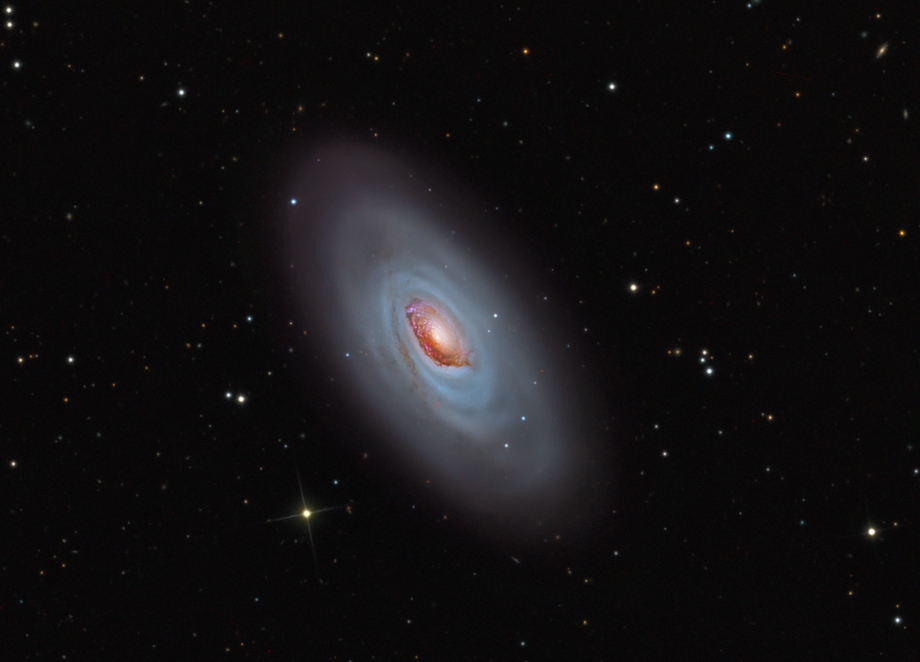
APOD 4.2: The Black Eye Galaxy
Thursday, March 28, 2013
APOD 4.1:Large Magellanic Cloud

Tuesday, March 26, 2013
Astronomy Observation Log 3.3 (Astronomy Cast - Exploration of Venus)
Apparently, the planet Venus has also been the subject of a number of in-depth explorations, even if these efforts haven't been as publicized as those of Mars.
The science fiction interpretation of the past was interesting and almost funny- the speakers recount a story, perhaps by Asimov, that was adapted into a movie in which people lived on the warm wet world that was Venus, which would only be clear of rain every 20 years. One child was stuck inside during the "fun" of a clear day, which seemed sad at first, except the kids that went out to play all died horrible deaths burning in sulfuric acid. He ended up being lucky for being unlucky.
Scientists had no clue what was going on with Venus. From Earth we could see it had an atmosphere and that it had phases. By 1960 when we started bouncing radio waves off the surface we could see it was a rocky planet. It was not until 1962 we knew it was a "hell-scape" with insanely high temperatures, totally unfit to be considered a planet capable of harboring life. In the 60s there were many failed missions to Venus.
"Venera 4" in 1967 finally measured the atmosphere of Venus- not only was it hot there, it was 95% carbon dioxide, totally different from what astronomers expected. The atmosphere is so thick (it's 22 miles thick) it could almost crush spacecrafts. Many engineering challenges were faced. Probes, devices and communication methods indeed need to be able to penetrate through 22 miles of sulphuric hail.
In the late 1970s, through the "Pioneer" program we sent four different probes through Venus' atmosphere to take data as they traveled- not only did the atmosphere have extremely high pressure, but we learned the winds are incredibly turbulent. Yet a certain altitude in the cloud layer, you can get a pressure and temperature that are the same as those found on Earth (even though you couldn't breathe the air, you could sit outside in this area if you were on some floating station).
Venus is fascinating to observe, with evidence of past oceans, vortexes in the polar region of the atmosphere near the South Pole, and the presence of hydroxyls. The main problem is protecting the instruments against the intense heat... After that, the pressure bearing down on all sides is the problem. At least the Russians have got some steel-reinforced drawing boards! The Russians have historically seemed to have the upper hand in Venus exploration.
The science fiction interpretation of the past was interesting and almost funny- the speakers recount a story, perhaps by Asimov, that was adapted into a movie in which people lived on the warm wet world that was Venus, which would only be clear of rain every 20 years. One child was stuck inside during the "fun" of a clear day, which seemed sad at first, except the kids that went out to play all died horrible deaths burning in sulfuric acid. He ended up being lucky for being unlucky.
Scientists had no clue what was going on with Venus. From Earth we could see it had an atmosphere and that it had phases. By 1960 when we started bouncing radio waves off the surface we could see it was a rocky planet. It was not until 1962 we knew it was a "hell-scape" with insanely high temperatures, totally unfit to be considered a planet capable of harboring life. In the 60s there were many failed missions to Venus.
"Venera 4" in 1967 finally measured the atmosphere of Venus- not only was it hot there, it was 95% carbon dioxide, totally different from what astronomers expected. The atmosphere is so thick (it's 22 miles thick) it could almost crush spacecrafts. Many engineering challenges were faced. Probes, devices and communication methods indeed need to be able to penetrate through 22 miles of sulphuric hail.
In the late 1970s, through the "Pioneer" program we sent four different probes through Venus' atmosphere to take data as they traveled- not only did the atmosphere have extremely high pressure, but we learned the winds are incredibly turbulent. Yet a certain altitude in the cloud layer, you can get a pressure and temperature that are the same as those found on Earth (even though you couldn't breathe the air, you could sit outside in this area if you were on some floating station).
Venus is fascinating to observe, with evidence of past oceans, vortexes in the polar region of the atmosphere near the South Pole, and the presence of hydroxyls. The main problem is protecting the instruments against the intense heat... After that, the pressure bearing down on all sides is the problem. At least the Russians have got some steel-reinforced drawing boards! The Russians have historically seemed to have the upper hand in Venus exploration.
Sunday, March 24, 2013
APOD 3.8: Sakurajima

APOD 3.7: Tardigrade!

The picture, credited to Nicole Ottawa and Oliver Meckes, is one of the weirdest coolest things I've ever seen- especially since it's actually a real picture from nature from an electron micrograph. The milimeter-long creature is an adorable moss piglet- aka the tardigrade. Officially, this polyextremophile is a new favorite animal of mine, and it's also a subject of close study. Since it can survive such incredible pressures, it was the first animal to be sent into space, and it survived hard vacuum. It was tested in 2011, actually outside the space shuttle. Tardigrades are extremely hardy, being able to go for decades without food and water, survive far above the boiling point or near absolute zero, and survive under direct exposure to dangerous radiation. This is partly because they can repair their DNA and reduce body water content to a few percent. Tardigrades were also launched to the Martian moon Phobos on Russian mission Fobos-Grunt, but the rocket failed and they only stayed in Earth orbit.
Thursday, March 7, 2013
Dorothea Klumpke Roberts
Letts
1
Olivia Letts
Mr. Percival
Astronomy, Per. 3
7 Mar. 2013
Dorothea
Klumpke Roberts: Life and Contributions
Dorothea
Klumpke Roberts was born in San Francisco in 1861, where her German immigrant
father John Klumpke arrived and attempted to strike it rich in gold. While his gold prospecting efforts were
a flop, he became a wealthy real estate broker instead, and fathered five
daughters and two sons with his new wife.
One son died in infancy and the other became a businessman, though
Dorothea, the third born, and her four sisters all became renown for their
artistic, musical, and scientific pursuits. The girls were all educated in elite schools in Germany,
Switzerland, and France; Dorothea ended up enrolling at the University of Paris
(the Sorbonne), where she switched from studying music to studying her true
passion, astronomy. After
attaining a Bachelor of Science degree in 1886, she received a post at the
eminent Paris Observatory. Here,
she worked on a 34 cm refractor with which to photograph the minor planets, or
asteroids. Her skill set was
mathematical in nature, and she also measured star positions, and studied
meteorites and stellar spectra.
That same year, Scottish astronomer Sir David Gill and Director of the
Paris Observatory Admiral Amédée Mouchez initiated a “Carte du Ciel” project to
create an atlas of the entire sky, including all stars even down to the 14th
magnitude and a list of those down to the 11th magnitude. As the Paris Observatory was to handle
a major portion of the sky, there was fierce competition for Director of the
Bureau of Measurements, who would head the bureau in handling plate
measurements and reductions.
Dorothea Klumpke won this position and held it until 1901; the project
was a success. Her doctoral
thesis, “L’étude des Anneaux de Saturne,” a mathematical insight into Saturn’s
rings, was highly acclaimed and well-defended,
Letts
2
thus Klumpke became the first woman
ever to attain the Docteur-és-Sciences degree. In 1896 she traveled to Norway for a solar eclipse that
ended up being obscured by clouds, yet she met her future husband Dr. Isaac
Roberts, a pioneer astronomer who produced the first good pictures of the
Andromeda Galaxy. In 1899, the
Meudon Observatory chose Dorothea Klumpke to ride in a hot air balloon called La
Centaure above Paris to observe a Leonid
Meteor Storm. The numerous Leonids
are from the comet Temple-Tuttle and seem to come from the constellation Leo,
after which they were named. In
1799, 1833, and 1866 the Leonids filled the skies with magnificent shooting
stars, but only 15 of them were observed during Klumpke’s seven-hour balloon
flight. Still, her ride only made
her more popular and was a milestone for women in the male-dominated field of
astronomy. In 1901, when Dorothea
married Dr. Roberts, she left the Paris Observatory for her husband’s
observatory and home in Sussex, which he called “Starfield.” She assisted him in his project to take
pictures of all 52 Herschel Areas of Nebulosity, although he died three years
later, and all his money and astronomical equipment went to her. She completed the remainder of the work
and brought all the photographic plates with her back to Paris, where she went
back to work for the Paris Observatory and spent years measuring, reducing, and
printing she and Isaac’s work. It
was not until 1929 that she published "The Isaac Roberts Atlas of 52
Regions, a Guide to William Herschel's Fields of Nebulosity,” to which she
added a supplement in 1932. Dorothea Klumpke
Roberts published two photographic atlases and deep sky object catalogues for
which she attained the Hèléne-Paul Helbronner prize from the French Academy of
Sciences. In 1934, for 50 years of
astronomical study, the president of France awarded her highest honor as she
was elected a Chevalier of the Legion d'Honneur. She spent the rest of her days in San Francisco with her
sister Anna, who was a famous painter and protégé/companion/heir to Rosa
Bonheur. Two minor planets were
named in honor of Dorothea Klumpke Roberts, along with the Astronomical Society
of the Pacific’s Klumpke-Roberts Award.
Friday, March 1, 2013
APOD 3.6: Mercury

Thursday, February 28, 2013
Dorothea Klumpke- Bibliography Listings
"Dorothea Klumpke Roberts Biography, Life and Career Facts, Invented." Web log post. Info. Page Rank Studio, 29 Sept. 2010. Web. 27 Feb. 2013. <http://pagerankstudio.com/Blog/2010/09/dorothea-klumpke-roberts-biography-life-and-career-facts-invented/>.
Jones, Jane H., and Don Stone, comps. Dorothea Klumke and the 1899 Leonids. Rep. Leonid MAC, n.d. Web. 27 Feb. 2013. <http://leonids.arc.nasa.gov/Klumpke.html>.
Roberts, Dorothea Klumpke. "Woman's Work in Astronomy." Publications of the Astronomical Society of the Pacific 31.182 (1919): 216-19. JSTOR. Web. 27 Feb. 2013. <http://www.jstor.org/stable/40692050>.
Stone, Don. "Dorothea Klumpke Roberts, Pioneer Woman Astronomer." AANC. Astronomical Association of Northern California, 2002. Web. 28 Feb. 2013. <https://sites.google.com/site/aancsite/articles/donstone>.
Jones, Jane H., and Don Stone, comps. Dorothea Klumke and the 1899 Leonids. Rep. Leonid MAC, n.d. Web. 27 Feb. 2013. <http://leonids.arc.nasa.gov/Klumpke.html>.
Roberts, Dorothea Klumpke. "Woman's Work in Astronomy." Publications of the Astronomical Society of the Pacific 31.182 (1919): 216-19. JSTOR. Web. 27 Feb. 2013. <http://www.jstor.org/stable/40692050>.
Stone, Don. "Dorothea Klumpke Roberts, Pioneer Woman Astronomer." AANC. Astronomical Association of Northern California, 2002. Web. 28 Feb. 2013. <https://sites.google.com/site/aancsite/articles/donstone>.
Tuesday, February 26, 2013
..::h e l i x n e b u l a::..

NGC 7923. Also known as Caldwell 63. Best known as the Helix Nebula. Sometimes referred to as The Eye of God.
This planetary nebula is well-deserving of the dramatic nickname due to its beauty and shape. And God would get a pretty decent view of Earth anyhow, because of all the bright planetary nebula, the Helix Nebula is one of the closest to our planet- about 700 light-years away.
The Helix Nebula is located in the constellation Aquarius (...some say that the Age of Aquarius has dawned!). The very bright core we see in pictures is a nucleus that is to become a white dwarf star; it is so energetic that gases expelled around the area glow bright. In the attached image, this core is bright red from the infrared wavelength used for the picture. Around the core, the excitation temperature changes frequently in different areas. It is estimated that the age of the planetary nebula is about 10,600 years, give or take a couple thousand. In the helix there are also many "cometary knots"which are the result of an electric discharge phenomenon.
Sunday, February 24, 2013
Astronomy Observation Log 3.2 (Astronomy Cast - Nebulae)
In place of an astronomy observation, I decided to listen to a podcast from astronomycast.com on my favorite celestial object- the nebula.
Dust and gas compose the beautiful nebulae that we all see in pictures. One of the speakers of the podcast denoted them as "everything-" having to do with stars, I think. They are huge.
Cold temperature condenses regions, keeps them dark. With emission and reflection nebulae, however, the heated gas gives off light in different colors.
I learned that if you're seeing a star "on the other side of the nebula," you're going to see it as red. But if you see one off to the side, you see the blue and the green (in reflection nebulae).
When you crank the energy up, that's when you get emission nebulae. In emission nebulae the stars also tend to be embedded in the cloud of gas. -I am now less confused about the differences between the types of nebulae- Reflection nebulae are cooler, emission ones are hotter.
The light we see does not come directly from the stars, but from absorption lines, where the light is re-emitted. We see oxygen lines in planetary nebulae, as they are still hot.
Gas becomes tens of thousands of degrees, and gravity pulls the gas together, but something has to cause it to collapse.
The bubble structures we see in nebulae are stars beginning to ignite and blow matter around them. And to see stars forming within them, we need infrared light.
The female narrator discussed stars that were likely to go supernova, and star clusters that show what our Sun may have looked like during its formation. Planetary nebulae and supernova are the forms of dead stars, on the other hand. The crazy shapes we see in nebula are defined by the physics of how the gas is moving. Some nebulae form over long periods of time (brightening, expanding, fading...), others form in a sort of "splat," depending on the stars.
Dust and gas compose the beautiful nebulae that we all see in pictures. One of the speakers of the podcast denoted them as "everything-" having to do with stars, I think. They are huge.
Cold temperature condenses regions, keeps them dark. With emission and reflection nebulae, however, the heated gas gives off light in different colors.
I learned that if you're seeing a star "on the other side of the nebula," you're going to see it as red. But if you see one off to the side, you see the blue and the green (in reflection nebulae).
When you crank the energy up, that's when you get emission nebulae. In emission nebulae the stars also tend to be embedded in the cloud of gas. -I am now less confused about the differences between the types of nebulae- Reflection nebulae are cooler, emission ones are hotter.
The light we see does not come directly from the stars, but from absorption lines, where the light is re-emitted. We see oxygen lines in planetary nebulae, as they are still hot.
Gas becomes tens of thousands of degrees, and gravity pulls the gas together, but something has to cause it to collapse.
The bubble structures we see in nebulae are stars beginning to ignite and blow matter around them. And to see stars forming within them, we need infrared light.
The female narrator discussed stars that were likely to go supernova, and star clusters that show what our Sun may have looked like during its formation. Planetary nebulae and supernova are the forms of dead stars, on the other hand. The crazy shapes we see in nebula are defined by the physics of how the gas is moving. Some nebulae form over long periods of time (brightening, expanding, fading...), others form in a sort of "splat," depending on the stars.
Subscribe to:
Posts (Atom)