
Friday, April 26, 2013
APOD 4.5: Lunar Eclipses

Friday, April 19, 2013
APOD 4.4: ISS Lookout

Currently, Expedition 35 is commanded by Colonel Hadfield. The crew is to stay aboard until May.
Saturday, April 13, 2013
Astronomy Podcast 4.1: How the World Will Really End
I wanted to know exactly what sort of chain reaction would trigger/occur during the end of all life on Earth, so I listened to Astronomy Cast episode 285.
There are a lot of silly theories as to how the Earth will really end. There is a constant pattern of people trying to frighten others with such theories. Well, I didn't get a straight answer.
Recently there was one theory about a "rogue planet X" coming out of some strange orbit causing a catastrophic polar alignment switching in our own orbit. This extra planet was in the Mayan stone carvings, while some research discusses an extra star, that is coming. -The speaker was sarcastic the whole time while describing this rogue planet theory- The other speaker was, meanwhile, debunking this theory as there is no giant object obscuring our vision of the sky. No stars are "winking out" as this "rogue planet" heads towards us. Frequently, when these apocalypses don't occur, the most common excuse is that the calculations for timing were wrong.
Solar flares that shake up the Earth's magnetic field, however, are worrying. Communication satellites even lose their lives in the face of solar flares as well.... (all this was relevant because a solar flare recently occurred that may also produce pretty aurorae as discussed in the podcast as a result of these phenomena)
Every year, the Sun, the Earth, and the center of our galaxy roughly line up since the center of the galaxy is in the constellation of Sagittarius, and the Sun of course passes through Sagittarius in December. Some people think this is a sign that some crazy laser alignment is going to come about and cause catastrophes.
A growing black hole slowly eating away at Earth is a possibility in the future. Or, our universe could spontaneously collapse into another.
According to the speaker, our universe is always experiment with itself- particularly with AGN- an active galactic nucleus.
Getting hit by a comet or asteroid is actually the thing that is likely to happen to Earth. According to all current data, an asteroid could come close to destroying the Earth but is more likely not to actually destroy it. If an asteroid was going to come incredibly close to the Earth, anybody could find out and it would be common knowledge even among amateur astronomers. Passionate astronomers can't keep secrets anyhow! Scientists aren't exactly involved in conspiracy theories.
As for aliens, if there is an alien force that is actually big enough to invade our planet, we would certainly see them coming.
APOD 4.3: A Recent Solar Flare

The picture, taken from the Solar Dynamics Observatory, does not portray the real colors of course as it is in extreme ultraviolet light. The solar flare was an M6.5 class flare erupting from active region AR 11719, which is near the center of the solar disk. The sunspot areas of visible light are regions with intense magnetic fields and they become more prominent as solar maximum approaches. Other glowing areas designate glowing plasma tracing the magnetic field lines. The coronal mass ejection that occured will have an effect on the Earth's magnetosphere, leading perhaps to auroral displays.
Friday, April 5, 2013
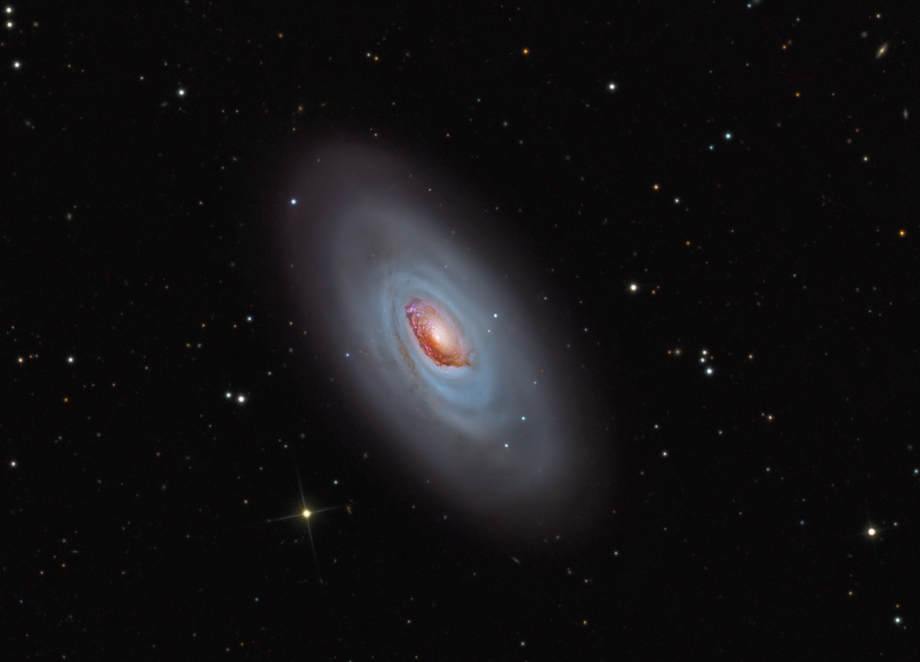
APOD 4.2: The Black Eye Galaxy
Thursday, March 28, 2013
APOD 4.1:Large Magellanic Cloud

Tuesday, March 26, 2013
Astronomy Observation Log 3.3 (Astronomy Cast - Exploration of Venus)
Apparently, the planet Venus has also been the subject of a number of in-depth explorations, even if these efforts haven't been as publicized as those of Mars.
The science fiction interpretation of the past was interesting and almost funny- the speakers recount a story, perhaps by Asimov, that was adapted into a movie in which people lived on the warm wet world that was Venus, which would only be clear of rain every 20 years. One child was stuck inside during the "fun" of a clear day, which seemed sad at first, except the kids that went out to play all died horrible deaths burning in sulfuric acid. He ended up being lucky for being unlucky.
Scientists had no clue what was going on with Venus. From Earth we could see it had an atmosphere and that it had phases. By 1960 when we started bouncing radio waves off the surface we could see it was a rocky planet. It was not until 1962 we knew it was a "hell-scape" with insanely high temperatures, totally unfit to be considered a planet capable of harboring life. In the 60s there were many failed missions to Venus.
"Venera 4" in 1967 finally measured the atmosphere of Venus- not only was it hot there, it was 95% carbon dioxide, totally different from what astronomers expected. The atmosphere is so thick (it's 22 miles thick) it could almost crush spacecrafts. Many engineering challenges were faced. Probes, devices and communication methods indeed need to be able to penetrate through 22 miles of sulphuric hail.
In the late 1970s, through the "Pioneer" program we sent four different probes through Venus' atmosphere to take data as they traveled- not only did the atmosphere have extremely high pressure, but we learned the winds are incredibly turbulent. Yet a certain altitude in the cloud layer, you can get a pressure and temperature that are the same as those found on Earth (even though you couldn't breathe the air, you could sit outside in this area if you were on some floating station).
Venus is fascinating to observe, with evidence of past oceans, vortexes in the polar region of the atmosphere near the South Pole, and the presence of hydroxyls. The main problem is protecting the instruments against the intense heat... After that, the pressure bearing down on all sides is the problem. At least the Russians have got some steel-reinforced drawing boards! The Russians have historically seemed to have the upper hand in Venus exploration.
Subscribe to:
Posts (Atom)